Monday, May 12, 2008

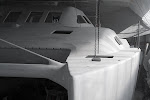
starboard hull hanging in the breeze

Here's a picture of the mold being broken down while the hull is suspended from the shop rafters. Notice the stack of mold forms in the lower right hand corner of the photo.

disassembling the mold


Next step........reaching around and unscrewing all the screws that hold all the stringers onto the mold forms.

lift in process


Here's the hull being lifted off the forms. Notice the plastic strips that were placed along the plank seams to keep excess glue from sticking to the stringers.

lifting the starboard side hull


Finally........time to lift the starboard side hull off the mold. I first used an automotive jack and a length of 2x4 placed under the forward bulkhead and lifted the hull about two inches off the mold. This gave me enough room to slip lifting straps under the hull in three places. Using three chain hoists strapped to the rafters, I then lifted the hull about a foot high to provide access to the screws that hold the stringers to the mold forms.

Sunday, May 04, 2008

timing the flow...


sometimes it's possible to get an idea of how things are progressing during an infusion by marking saturation lines and timing the progression. Above, you can see the start, 3 min line and the six min line. ....notice the distance betweent the 3 and the 6 is slightly shorter than the start to 3. That's an indication that the resin is slowing down due to its' increasing viscosity.

another little resin infusion clip

video

pulling resin into a vacuum bag ( resin infusion) is a lot cleaner than wet layup / bagging but it takes a little practice and a bunch of mistakes to learn how best to set up the flow.

It's easy to dive off the deep end into developing technique and experimentation but it's still hard to beat a simple wet layup that's finished off with a bondo spreader and peel ply. ..........knowing when to use the simplest or quickest methods goes a long way towards insuring you keep the project rolling.

infusion clip

video

resin infusion with a parrot on your shoulder and a video camera in one hand is a bit of a challenge..........

resin infusion


Here you can see the resin being sucked into the bag. infusion requires a good deal of prep work and if you set things up right, it is a very pleasant technique that minimizes potential contact w/ the resin and it can be very neat to watch......it's just a matter of using 3M77 to tack all your dry glass in place, wrap the part w/ peel ply, decide how to pull your resin, build a periferial vacuum manifold, w/ a resin brake then tap the center so that resin can flow outwards.

In this instance, I din't get a full infusion but it's easy to just tap into the bag where it's dry and repeat the process until you get your part.

Parts do come out really nice when things go right......

infusing the starboard side rinterior rails


here's some prep work involved in doing a resin infusion of the interior side rails....these are 10 inch wide webs that have unidirectional glass on the edges that get's bonded into the interior of the hulls. Infusing with system III Silver tip is difficult at best. I find it to be too viscous but if you use plenty of flow media it's possible.

Tuesday, April 15, 2008

another shot looking forward ....

Preparing the hull sections:


The inner starboard shell is seen here hanging from the rafters of the shop about 10 inches shy of the final resting place. Since I opted to use the foam strips where the bulkheads meet the hulls, I've got a fair amount of scribing, fitting and trimming to do before I invite my friends over for a big cake decorating icing bag, bonding party.........( come to think of it, I need to make sure that I cut the internal access holes in the forward bulkheads so I don't accidentally bond one of my friends into the forward compartments by mistake)


now mixing the epoxy........


bagging the epoxy in preparation of application to the bulkhead edges.....


oops.................

fitting the inner starboard hull section

After a few hours of winching, strapping, grunting, pulling, pushing and pouting......I managed to wrangle the inner starboard side hull section into the general position over the starboard side hull section. From here, I'll spend some time lowering, marking, cutting, lowering check fitting, re-marking, raising, cutting and trial fitting things in preparation of bonding the two hull sections together.

Sunday, April 13, 2008

more inspections....

Tang is seen here inspecting the high density foam section of the starboard bow bulkhead. The stem bulkhead is glassed in on the inside and has only been rough cut for now on the outside. From this section forward, will be solid foam shaped and glassed over to form the bow stems.

dragging the inner starboard side hull half

My inner starboard side hull half had to spend a little time in the cold sitting outside by itself along the side of the shop. I glassed it inside and out and decided that the peel ply would prevent any real UV damage. Since it only had to deal with the low winter time sun of the Pacific Northwest, it didn't seem to be any worse for wear.

Todays challenge will to use three chain hoists, straps, levers inclined planes, rollers, ropes, come-alongs, ratchet straps, and mental telekinesis to position this hull section over the outer hull section that is waiting in the mold.

Starboard side bulkheads

Here's Tang walking the plank beside the outer starboard side hull section. I ran this plank along the center line tops of the mold forms to create a convenient walkway.

Friday, April 04, 2008

starboard side aft bulkhead

The aft bulkhead is shown here after being bonded in place. This is the last of the main hull bulkhead installs.

Tuesday, March 18, 2008

pre-fitting the starboard Mast bulkhead

I'm fitting the mast bulkhead on the right. Again, I set the bulkhead in place then use my sharpy marking tool to give me a 3/4 in. offset mark ( same thickness as the optional foam strips) then I lay the bulkhead down flat and use the saber saw to cut the line. After that, the bulkhead fits perfect on top of the tapered foam edge strips.

Posted by Picasa

Monday, March 17, 2008

two layers.....


I use a small roller to spread epoxy on the seams then apply two layers of DBM1708 tape with a 3/4 inch offset. This tape is easily worked into the fillet/epoxy mix and once in place, I cover the join area with strips of peel ply.

setting the bulkhead in place


I slathered plenty of filler on the hull, placed the foam strip down, slathered more goop on top of the foam strip then slid the bulkhead in its' place. A quick once over with a bondo spreader that has a 2 in radius edge on it helps create a nice smooth corner that can then be covered with 6 in. wide DBM1708 fiberglass tape.

marking the bulkheads


Since the foam strips are 3/4 in. thick, I made a scribing tool with a piece of scrap foam and a sharpy pen. Once I have my mark, I cut the excess off the edges of the bulkhead with a saber saw fitted with a carbide grit blade. ( I mark both sides because the hull is not always at a right angle to the bulkhead and when I make the cut, I set the saw blade at an angle and try to cut to the lines on both sides of the bulkhead ) Since I use plenty of epoxy fill when I make th join, it dosen't have to be perfect.