7.21.2012

Grandmas Isocynate biscuits.... AWLGRIP primer surfacer

AwlGrip contains isocynates and other stuff that will do great harm to carbon based life forms like myself.  In the past, neglegent release of this compound was responsible for over 2000 deaths in Bhopal india. .  http://en.wikipedia.org/wiki/Bhopal_Disaster To prevent myself from becoming another victim,  I configured a nice forced air breathing apparatus.  

 If you happen to have a vintage craftsman air compressor, I have found that it is possible to use one to configure a nice,  workable forced air breathing apparatus.  I did this by flushing the crank case of this old slow speed four cylinder compressor and replacing the lubricant with vegetable oil. I attached a long flexible tube to the outlet and ran it to one of the filter elements that screw on the a full faced mask.  To do this, I simply drilled a hole in the side of a filter unit and taped up the front inlet of both filters. When worn, it sort of smells like my grandmothers kitchen when she was making biscuits. That's a much nicer smell than Isocynate.

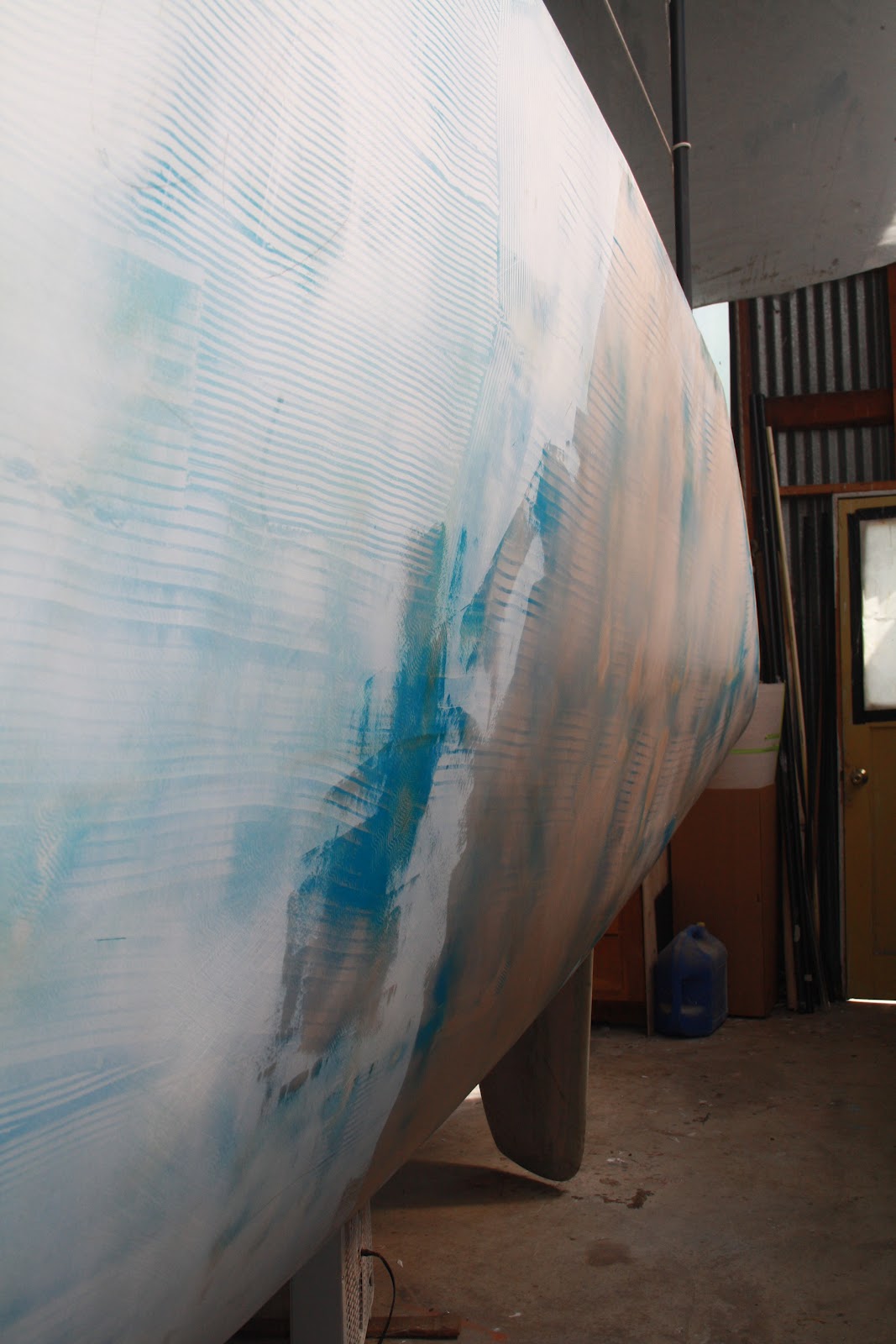
Here I am sitting on the starboard side aft bridge deck after painting the boa† with her first coat of AWLGRIP 8003 high build primer surfacer.  This stuff is really nice.  It's a two part epoxy primer that cures into a very robust coating that sands as smooth as glass.  

port side stern boarding steps

port side bow

starboard bridge deck, targa bar and stern dingy landing deck.

port side view.

7.10.2012

ladder, bucket, anchor


Although this may seem like an off target post, I include it as an example of why it is sometimes nice to have a few random things lying around the shop.  As luck would have it, the anchor height = ladder + bucket.  

In preparation for painting, I realized that I had not yet installed the anchor line tube into the forward portion of the lower bridge deck. To do this, it was necessary for me to gather up the ground tackle and temporarily put all the pieces together to determine the proper angle of the entrance tube.  This small tube is not shown in the photo but it needed to be installed so that under tension, the anchor rode will be concentric with the axis of the anchor roller and the power windlass

This will be my hurricane anchor.  It is a Fortress  FX - 85 which has a working load of 5200 lbs.    


*  in the lower portion of this photo, you can also see the mast which is suspended from the shop rafters at head level.  As a reminder if it's existence, I often bash my head into it.  

7.09.2012

Visual proportioning

As a first step in the painting process, it is important to make sure that the boat is the right shape. Since all joints are covered with double biased tape, this results in a slight surface discontinuity. One way to deal with this is to sand the edges of the tape then apply some filler compound. I have found it best to use a mixture of epoxy and glass micro balloons over all the seams, sand them and then apply a ready formulated faring compound. System Three offers a really nice product called "QuickFair" and although it is sinfully expensive,  if you apply it with a blade, very little final sanding is required. 

To mix the filler. here's a little trick I taught myself that makes mixing easier. I call it visual proportioning. I mark out a proportional surface area on a cookie sheet and cover the areas.  By varying  the thickness of each component, it is possible to control the volume of faring compound required for particular jobs.   


two parts A to one part B filler

visual proportion

mixing

smoothing and sanding the port side stern steps and kick up rudder box.

6.21.2012

sea life entangled in catamaran netting


To provide attachment points for the bow netting,  I glassed carbon fiber tubes over the edges of the front bow deck, along inside forward hull and along the bow beam.  I Then used a one inch hole saw to create openings every 6 inches.  When I install my netting ( dyneema Ultra-cross) I'll run fiberglass rods through the tubes and lace dyneema through the holes, around the internal rod and back to the tramps.  The center plank between the tramps has chamfered holes through high density filler.  I chose this option because it seemed to be the smoothest method of attachment which should prevent me from stubbing my toes on hooks, fittings and other methods of attachments and I think it results in a nice clean flowing look.


then again..............

one of the hazards of these types of nets is that sea life has been known to become entangled in them.


6.15.2012

Popsicles with cable steering


This F-44SC has twin steering stations that operate twin rudders via a cable pulley system.  This means that both steering wheels will turn at the same time and to link them together, a cable / chain / sprocket loop will be used.  Since the fridge / freezer lies along the cabin bulkhead, I had to create a pass through that will allow the cables to run from one steering sprocket to the other.  {  the bolt in the photograph is NOT the bolt that will be used and is only being used temporarily for mock up purposes.  All pulleys are aircraft grade aluminum with ball bearings with 9/16 stainless bolts as shafts.)

The fridge / freezer lies along the inside cabin bulkhead and the cables linking the twin steering wheels must pass through the lower. inside, aft corner. To create this pass though, I found myself needing a 6 ft. long; 2 inch diameter hole saw to use to cut through the low density foam insulation that I had previously poured in place.


a couple of minutes with a chop saw and a metal chain link fence pole resulted in a tool that I don't think I could have found at the hardware store.  Using a pipe wrench , I was able to applying a little axial force and torque by hand and I was able to create a nice 2 inch hole all the way through the lower aft corner of the fridge / freezer.  Since the fridge / freezer uses 6 inch thick low density polyurethane foam insulation along the sides and 8 on the bottom,  this pass through hole should not compromise the insulating properties of the icebox..... especially if I seal off the air space by tucking a little foam around the cables once they are installed.  If I find myself worrying about this at night, once the cables are in place, I could also fill the void with a bunch of those styrofoam beads that are inside those bean bag chairs.


Note: I intend to dine on popsicles in the noon day tropical sun, so I will do what I need to do at all cost to maintain that capability.  One thing that I learned while growing up in the deep south, is that summers are much more bearable if you have a good stockpile of orange and grape popsicles.


The steering system relies upon a total of 10 pair of pulley brackets and I was able to fabricate them using aluminum angle stock, a table saw fitted with a carbide tooth blade, a drill press and a belt sander.    I was able to do this without injury and without metal bits flying across the shop.  As long as you plan each cut and pay close attention to keeping all cuts even and straight, life is good, If you get in a hurry and any piece of metal gets caught as a slight angle,  your part will be flung into outer space after punching a hole in the roof of your metal shop. If your hands are positioned in the wrong place when this happens, it can pull your fingers into the blade and this could result in a delayed launch date.

Weight saving options: 

Steel                                     UHMW


  Steel cable for steering:  

7x19

7X19
DiameterApprox. Weight
Per 1000 Ft.
(lbs)
Galvanized
Minimum Breaking
Strength (lbs)
Stainless
Minimum Breaking
Strength (lbs)
3/32"17.41,000920
1/8"292,0001,760
5/32"452,8002,400
3/16"654,2003,700
7/32"865,6005,000
1/4"1107,0006,400
5/16"1739,8009,000

Weight of 120 ft of 5/16 wire = 20 lbs with a breaking strength of 9000 lbs

~~~~~~~~~~~~~~~~~~~~~~~~~~~~~~~~~~~~~~~~~~~~~~~~~


amsteel blue steering "cables"


DIA.
Inch.
CIRC.
Inch.
AVG TENSILE STRENGTH (lbs.)APRX. WEIGHT
(lbs. per 100ft.)
1/8"3/8"2,2000.50
3/16"9/16"5,5001.00
1/4"3/4"8,4001.70
5/16"1"13,2002.60

Weight of 120 ft of dyneema = 3.12 lbs   with a breaking strength of  13,200 lbs


Conclusions:  Amsteel blue is about 6 times lighter and 70 percent stronger by size.  In this post, stretch has not been mentioned.  When using synthetic cables, it is expected that it will take a breaking in period to eliminate constructional stretch.  To make this easy. dead eyes with multiple ratios can be used.  It is also possible to incorporate conventional turnbuckles. 


6.13.2012

Adding lightness

My steering design makes use of four steel sprockets.  After ordering and receiving them, I was shocked to realize that they weighed in at almost three and a half pounds each.  With the aid of a CNC water jet cutter,  I was able to lighten each sprocket by a little over one pound each while maintaining the required strength and without compromising the design.


6.05.2012

final long board session.

finished long board shaping of v groove micro / epoxy of starboard inner hull. This was an 8 hr grueling effort that not only required applying upward pressure, it involved full body twisting action to insure that the surface remained fair.

As seen, dust protection was beyond mandatory, it was down right life saving.  At the time, I was listening to an interview on public radio.  Perhaps you can guess who was being interviewed by the distinctive voice.  hint:  comedian.


5.31.2012

"Should I go to the gym tomorrow?"

After using a v groove trowel to apply epoxy / micro on the lower inside portions of both hulls, now the fun begins..... The goal here is to create sweeping curves that show no indications of any surface variations resulting from the thermo forming and edge gluing of the molded core cell foam.

In the plans, Ian Farrier has a foot note saying that all fairing can be done while each hull quarter section is facing upwards.   Here I am paying the price:


after using this highly dangerous 3 ft long 5 h.p. hydraulic belt sander, I found that switching over to a manual "long board" allowed me to fine tune the surface and knock down the high points with a little more deft and control.


Note:  I'm using a full face respirator fitted with micro dust filters as well as a good pair of hearing protectors. 

5.26.2012

Improving the fish eye view.

My intentions were to allow myself a few cosmetic imperfections on the under side of this ship but since I  have chosen to use insanely expensive Awlgrip paint as my topcoat, it seemed like a shame to paint over a sub par surface.....so.  You guessed it.  Decided to trade a few more days under a palm tree for a few more days in the shop.   


You're looking at the under side of the port side aft hull.

I've used my v-grove trowel to apply micro / epoxy over the hull surface

Here's the port side escape hatch and if you look closely, you will notice that I am working my way forward with the filler. After this step is complete, I'll use the long board to knock it all down, apply another skim coat and then I'll have a fair surface for the fish to look at. 

I think any vehicle that has an escape hatch is worthy of note.  Ian Farrier doesn't mess around. 

Here's a shot of the under side of the port side hull.

5.23.2012

Endless sanding...... ( only four more weeks allowed)


Rather than burden the viewer with endless photographs of sandpaper, sanding boards, dust, dust masks, itchy sleeves and bulging shoulder muscles,  I have limited the number of recent posts.  Sanding and prepping for the top side painting of a boat is not very exciting nor much fun.  However, if you are really short on entertainment options, here are a few pictures of some of the tools with a brief description of some of the fairing methods that seem to be working for me.

After mixing my own bulk fairing compound using epoxy resin and glass micro balloons, and bringing all of the boat surfaces up to grade, I've switched over to a product called Quick fair made by Sysem Three.  It's a thixotropic fairing compound that is formulated under vacuum and when mixed, it is easily spread over the hull surface in such a was as to minimize any further rough sanding.  The stuff is insanely expensive but in this application, it is literally saving me a few days of my life that could otherwise be better spent sailing with my friends or sitting with my feet in the sand under a palm tree.


Quick Fair 


It mixes 2 : 1 so I just marked two areas out on my mixing board with a sharpy pen and then I scoop the stuff out, smooth it out over the areas in roughly the same thickness and call it good to mix.


I then use various steel blade "sheet rock" spreaders to smooth it out on the hull.   Since I've been using super low grit sand paper on long boards ( sometimes 20 grit), this filler eliminates these sand marks and will only require a quick go over with the Festool RO150 DA sander


here's a pile of the tools that I have been using to fair the hulls and deck


forward port side hull right before it runs you over.
   

4.13.2012

Bulkhead mounted steering wheel pedestals

The F-44SC has two steering stations.  Two 32 in destroyer style wheels will turn on 1 in. diameter stainless steel shafts supported by bearings on both the inside and outside of the cabin bulkhead.


shaping the bulkhead mounted steering pedestals. As backing plates for the two steering shaft bearings, I used 1//4 in. aluminum.  

vac bagging the steering pedestals in place. In the foreground, I have pre cut and shaped triaxial glass to fit the steering mount. 

port side

starboard side

port


starboard


For the interior steering shaft bearing supports, I chose to laminate 6 layers of glass over 8 inch square pieces of 3/4 in marine plywood.

starboard side interior bearing plate


port side interior bearing plate


4.05.2012

Time to configure the steering system

One of the challenges that arises when going with the kick up rudder option is that any mechanism designed to rotate the rudder shafts will also need to contend with any changes in geometry as the rudder is allowed to kick back upon hitting a large submerged anvil.

Rather than go with a complicated series of pivot arms, levers, cables chains and sprockets or with a 100 percent hydraulic steering, I have designed a simple, robust system that incorporates dyneema rope, aircraft grade pulleys (one system per hull with an alignment link system between the two.  The reason that I decided upon a design of my own were:
1.  I engineered it to handle stronger loads than most conventional steering systems..
2.  All components are available through Mc Master Carr and a local machine shop.
3. I will be able to repair and maintain this system anywhere in the world without needing to order specialty parts from far away marine supply houses.
4. The system is strong but very lightweight.

Here are a few photos showing some of the details of the design but without a schematic or sketch of the full design, it will be fairly difficult to see how all these details will come together so I will post a full description of my system once it has been completely installed.


  More will be revieled